oneworld Alliance: The Complete 2026 Guide
oneworld in 2026: the live 15-member roster, Ruby, Sapphire and Emerald benefits, the best frequent-flyer programmes to hold, the strongest…
Read article →Independent Miles Mosaic guide. No programme partnerships, no account linking, no scraped balances. Sources cited below; corrections welcomed.
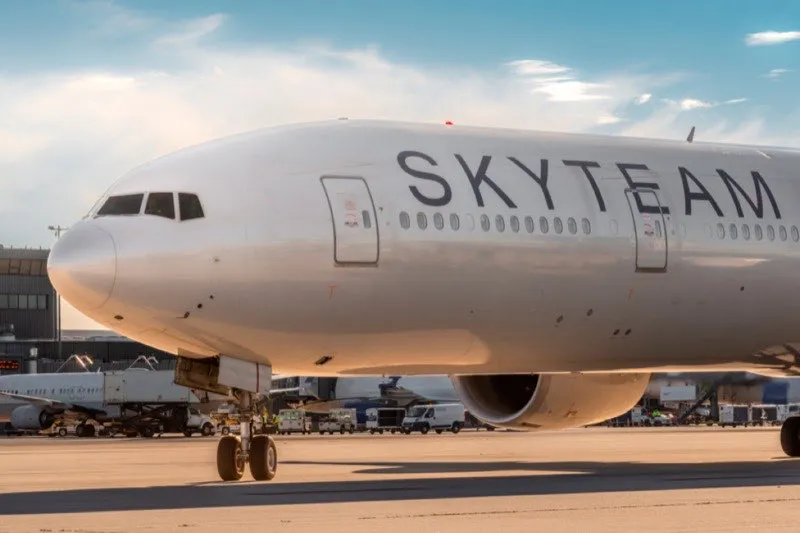
SkyTeam is often the most misunderstood of the three major airline alliances. Star Alliance gets credit for breadth. oneworld gets credit for glamour. SkyTeam gets reduced to a blurry mix of Delta, Air France-KLM, and a few regional names that most travellers barely remember.
That undersells it. In 2026 SkyTeam is a very workable alliance if you understand what it actually is: an integrated network with stronger airport reciprocity than many travellers expect, a meaningful Europe-U.S. axis through Air France-KLM and Delta, a live long-haul role for Virgin Atlantic, a newly relevant Scandinavian dimension via SAS, and a loyalty story that often comes down to choosing between Flying Blue's flexibility and Delta's domestic power.
Updated May 15, 2026: Current alliance facts were checked against live SkyTeam public materials and recent official SkyTeam press pages. ITA Airways formally exited SkyTeam on 30 April 2025 and joined Star Alliance on 1 April 2026, a move announced by Lufthansa Group as part of the carrier's integration with the German aviation group. Where older articles conflict with current roster or benefit pages, this article follows the current public alliance position.
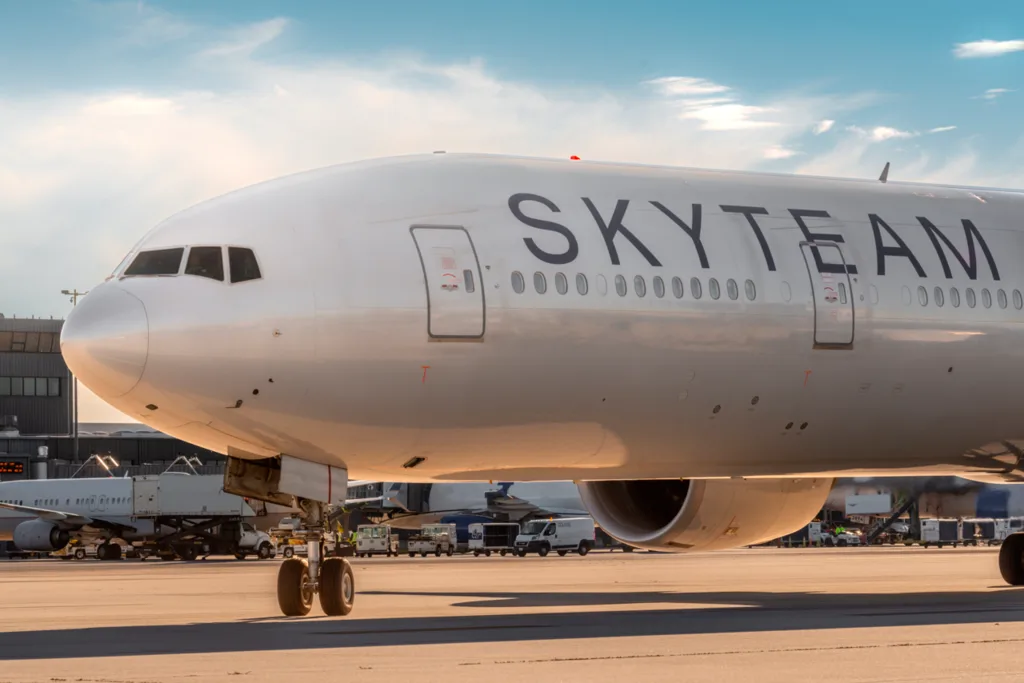
Recent official SkyTeam press materials describe an 18-member alliance connecting more than 945 destinations across 145 countries, with more than 750 airport lounges in the network ecosystem. The current public roster includes:
SkyTeam public materials also continue to list Aeroflot as suspended. That matters because many stale alliance guides still use a pre-suspension worldview or quote old member counts without context.
The other correction worth making plainly is that current SkyTeam materials show SAS (which joined in September 2024) and Virgin Atlantic (which joined on 2 March 2023 as the alliance's first UK member). They do not include ITA Airways. ITA formally departed SkyTeam on 30 April 2025 after announcing the exit in February 2025, and joined Star Alliance on 1 April 2026 as part of its integration into the Lufthansa Group. Any guide still treating ITA as a current SkyTeam member is wrong about the live roster.
The roster churn matters more than it looks. ITA's departure means Rome Fiumicino is no longer the SkyTeam-anchored hub it appeared to be in 2023, connecting traffic through FCO now flows through Star Alliance rather than into the Air France-KLM-Delta core. For Italy-based or Italy-routed travellers, that has reshaped the practical alliance choice. Conversely, SAS arriving with its Copenhagen, Stockholm, and Oslo hubs gives SkyTeam an obvious Scandinavian entry point that the alliance previously lacked. And Virgin Atlantic remains the alliance's most credible transatlantic premium product alongside Delta and Air France, which matters whenever the discussion turns to which alliance "feels" right for someone whose travel is anchored in London or the U.S. East Coast.
SkyTeam has two alliance tiers: Elite and Elite Plus. That looks simpler than oneworld or Star Alliance, and in practice it often is.
SkyTeam's own FAQ describes Elite benefits as including priority reservation waitlist where applicable, priority check-in counters, priority boarding or equivalent preferred boarding treatment, and extra baggage allowance. If you fly the alliance often in economy, Elite is useful but mostly operational.
Elite Plus is where the alliance becomes materially more valuable. SkyTeam says Elite Plus adds worldwide lounge access for members travelling on eligible itineraries, usually with one guest, priority baggage handling, stronger baggage allowances, and the broader airport experience often marketed under SkyPriority.
For most real travellers, Elite Plus is the target worth understanding because it changes the trip, not just the booking screen. SkyTeam now also operates a small but growing network of SkyTeam-branded lounges in markets where no member airline has its own facility, including Istanbul, Dubai, and Vancouver.
SkyPriority is the alliance's umbrella label for premium and elite handling at the airport, and it is the single most consistently used SkyTeam benefit. It is also the benefit most often oversold in marketing copy and underdelivered in the terminal. Understanding what it actually includes, and who genuinely qualifies, prevents disappointment.
SkyPriority is available to two distinct groups: passengers travelling in First or Business class on a SkyTeam-operated flight regardless of frequent-flyer status, and SkyTeam Elite Plus members travelling on a SkyTeam-marketed flight in any cabin. Elite (the lower alliance tier) does not automatically unlock SkyPriority everywhere, it brings priority check-in, boarding, and waitlist privileges at participating airports, but the full SkyPriority experience including priority security and immigration channels is reserved for Elite Plus and premium-cabin travellers.
In practice the SkyPriority experience looks like this. Dedicated check-in counters, often a single shared SkyPriority desk staffed by the operating carrier. Priority baggage drop. Priority security lanes at participating airports, note "participating", because at many secondary airports the SkyPriority lane simply does not exist. Priority immigration at a subset of major hubs (Paris CDG, Amsterdam, Atlanta, and Seoul Incheon are the most reliable). Priority boarding via a SkyPriority lane. Priority baggage delivery, with bags tagged for early offload. And a dedicated SkyPriority transfer desk at major hubs.
The benefit is most operationally meaningful at Air France, KLM, Delta, and Korean Air hubs, where SkyTeam carriers operate at scale and the SkyPriority infrastructure has been built to a high standard. It is least reliable at outstations where a SkyTeam carrier is one of many tenants and the local handler treats SkyPriority as a paper concept.
SkyTeam's lounge offering, more than 750 lounges between member-operated and partner facilities, is materially smaller than Star Alliance's 1,000-plus network but it has been growing faster in two specific directions. The first is the SkyTeam-branded lounge programme, which fills geographic gaps where no member carrier maintains its own facility. SkyTeam-branded lounges are now operating in Istanbul (IST), Dubai (DXB), Vancouver (YVR), and a handful of other strategic outstations. The second is the alliance's April 2025 extension of Elite Plus access to domestic itineraries on a curated list of member carriers: Aeromexico, Air France, China Eastern, Garuda Indonesia, Kenya Airways, KLM, Korean Air, SAS, Saudia, Vietnam Airlines, and XiamenAir. That change unlocked more than 70 additional lounges for Elite Plus members travelling on domestic flights, a real improvement on the prior international-only restriction.
Where SkyTeam still trails its rivals is North America. The Delta Sky Club network is enormous but Delta has tightened guest rules and capped annual visits for SkyMiles cardholders, narrowing practical access in 2025-2026. United Clubs and American Admirals Clubs give Star Alliance and oneworld members deeper U.S. coverage from a guest's perspective. SkyTeam compensates by being unusually strong in Europe (Air France's lounges at Paris CDG are now widely considered the best alliance lounges on the continent, with the new La Première Lounge and the upgraded Salon 2F being standouts) and in Asia, where Korean Air's KAL Lounges at Incheon and China Airlines' Premium Business Class Lounge at Taipei rank among the most refined Asia-Pacific business-class lounges in any alliance.
One operational quirk to remember: SkyTeam is the only alliance where lounge access is typically restricted to three hours before departure on originating itineraries, though connection itineraries are exempt. Star Alliance Gold members face no such time cap. The three-hour rule rarely bites in practice, but it can matter for early-morning travellers who like to arrive at the airport extra-early.

Delta, Air France, and KLM form the backbone of SkyTeam's relevance for many readers. If your travel frequently touches Amsterdam, Paris, London, or major Delta hubs, the alliance becomes much more useful than its brand perception suggests.
SkyTeam looks stronger in 2026 than older guides imply because the current alliance story includes Virgin Atlantic and SAS. Virgin gives the alliance a more appealing premium transatlantic option. SAS broadens Northern Europe relevance. Together they make SkyTeam feel less like a secondary choice and more like a coherent travel proposition for certain geographies.
Every alliance needs at least one programme that travellers can actually use as a strategic home. In SkyTeam that is often Flying Blue. Delta is powerful, but also highly dynamic and domestically tilted. Flying Blue is the programme that most often turns SkyTeam from "an alliance you happen to use" into "an alliance you can actively optimise."
Flying Blue is usually the first programme serious SkyTeam travellers should evaluate. It has an understandable XP-based status framework, it remains central to Air France-KLM's network, and it still runs monthly Promo Rewards that can create genuine value even though the programme no longer belongs in the "published award chart" era. If you want one alliance-wide programme to understand deeply, start here.
Delta makes sense when your travel is meaningfully U.S.-centric and Delta-operated. Its Medallion benefits can be excellent when they are actually used. But for many travellers, SkyMiles is not the most elegant alliance-wide redemption currency because of dynamic pricing and the way value often depends on U.S. network behaviour more than cross-alliance arbitrage.
Virgin Atlantic Flying Club deserves more attention in the SkyTeam discussion than it often gets. It gives the alliance another loyalty angle for travellers who already value Virgin's premium proposition or who want a different transatlantic gateway logic than Delta or Air France-KLM alone. Independent comparisons such as The Points Guy's SkyTeam programme breakdown consistently flag Virgin Atlantic and Flying Blue as the two most useful programmes for non-U.S. travellers.
Korean Air SKYPASS still publishes a fixed-zone partner award chart, an increasingly rare proposition in 2026. Awards on SkyTeam partners are bookable directly through the SKYPASS website and the chart gives Asia-Pacific travellers a more predictable redemption tool than Flying Blue's dynamic pricing or Delta SkyMiles. The caveats are real, SKYPASS has historically restricted family-pooling and award-booking flexibility, and Korean Air's surcharge approach varies by partner, but the programme remains one of the few SkyTeam currencies where you can still plan a long-haul redemption with chart-level confidence.
For most readers the practical decision tree is straightforward. If your travel is anchored in the U.S. and concentrated on Delta-operated metal, hold SkyMiles. If you fly internationally and want a programme that supports both reward booking and elite status across Europe and beyond, choose Flying Blue. If you fly Virgin Atlantic or want a London-anchored premium relationship, Flying Club is the natural home. If you fly Asia-Pacific routes and want a more predictable partner award redemption tool, SKYPASS still rewards programme literacy. None of the four is universally best; matching the programme to your route map and earning source is the actual answer.
SkyTeam used to offer a Round the World award through Korean Air and Delta SkyMiles. That award was suspended in mid-2022 and the last issue date for new tickets was 31 March 2023, per SkyTeam's own discontinuation notice. There is no current SkyTeam-branded round-the-world award product in 2026, and any guide implying otherwise is referencing a discontinued tool.
The practical alternatives are three. The first is to stitch together one-way Flying Blue redemptions on SkyTeam carriers. Flying Blue prices each segment dynamically, so a creatively routed multi-segment itinerary is feasible but you sacrifice the predictable pricing of a true RTW chart. The second is Korean Air SKYPASS, which retains a fixed-zone partner award chart and can be assembled into a multi-segment itinerary segment by segment, at meaningful effort, because SKYPASS's booking surface is not optimised for complex routings. The third is to step outside SkyTeam entirely: Asiana Club still publishes a Star Alliance round-the-world award at 140,000 miles in economy and 230,000 in business, and Lufthansa Miles & More offers a Star Alliance round-the-world at 180,000 miles in economy, 335,000 in business, and 500,000 in first.
For paid travel, Star Alliance still operates a paid Round the World fare product priced on total mileage and class of service. SkyTeam does not. If you genuinely want a chartable round-the-world award in 2026, the alliance answer is Star Alliance via Asiana or Miles & More, not SkyTeam.
The first mistake is expecting a stable old-school award chart environment. That is not where SkyTeam lives in 2026.
Delta is overtly dynamic, as confirmed in Delta's own award booking pages. Flying Blue remains more tactically interesting, with monthly Promo Rewards creating real opportunities, but it is not a fixed-chart comfort blanket either. The way to win in SkyTeam is not to pretend the old predictability still rules. It is to monitor current prices, stay flexible, and use Promo Rewards or selective partner opportunities when they surface.
SkyTeam can be especially useful when it solves a route problem cleanly: a Europe-U.S. itinerary via Paris or Amsterdam, a North Atlantic trip where Virgin Atlantic is the best onboard choice, or a regional connection pattern in Asia or Scandinavia where the member roster lines up neatly with your routing.
SkyTeam's value is not just in award booking. Elite Plus treatment, lounge access, through-checking, and SkyPriority services often make the alliance feel stronger in practice than it looks on a simple "sweet spots" spreadsheet.
SkyTeam in 2026 is not the forgotten alliance. It is the alliance that rewards people who understand its structure. Current public materials show an 18-member network reaching more than 945 destinations across 145 countries, with SAS and Virgin Atlantic improving the roster story and Flying Blue remaining the most broadly useful strategic currency for many readers.
If your travel pattern fits the alliance's real strengths, SkyTeam can be easier to live with and more rewarding than its reputation suggests. Just do not approach it with outdated ITA assumptions or a belief that fixed award charts will do the thinking for you.
Programme rules verified against the official sources below. External sites open in a new tab.
See your requalification forecast in under a minute. No account, and never a loyalty password.
Forecast my status, free →Share
Last reviewed: · How we research and update
oneworld in 2026: the live 15-member roster, Ruby, Sapphire and Emerald benefits, the best frequent-flyer programmes to hold, the strongest…
Read article →Star Alliance in 2026: the live 26-airline roster, Silver and Gold benefits, the best programmes to hold, and how to use the alliance witho…
Read article →Flying Blue in 2026: how XP works, current Silver, Gold, and Platinum thresholds, Promo Rewards, miles validity, and why it stays central t…
Read article →Delta SkyMiles in 2026: MQD-led Medallion status, earning and redeeming miles, where dynamic pricing changes strategy, and what Delta still…
Read article →